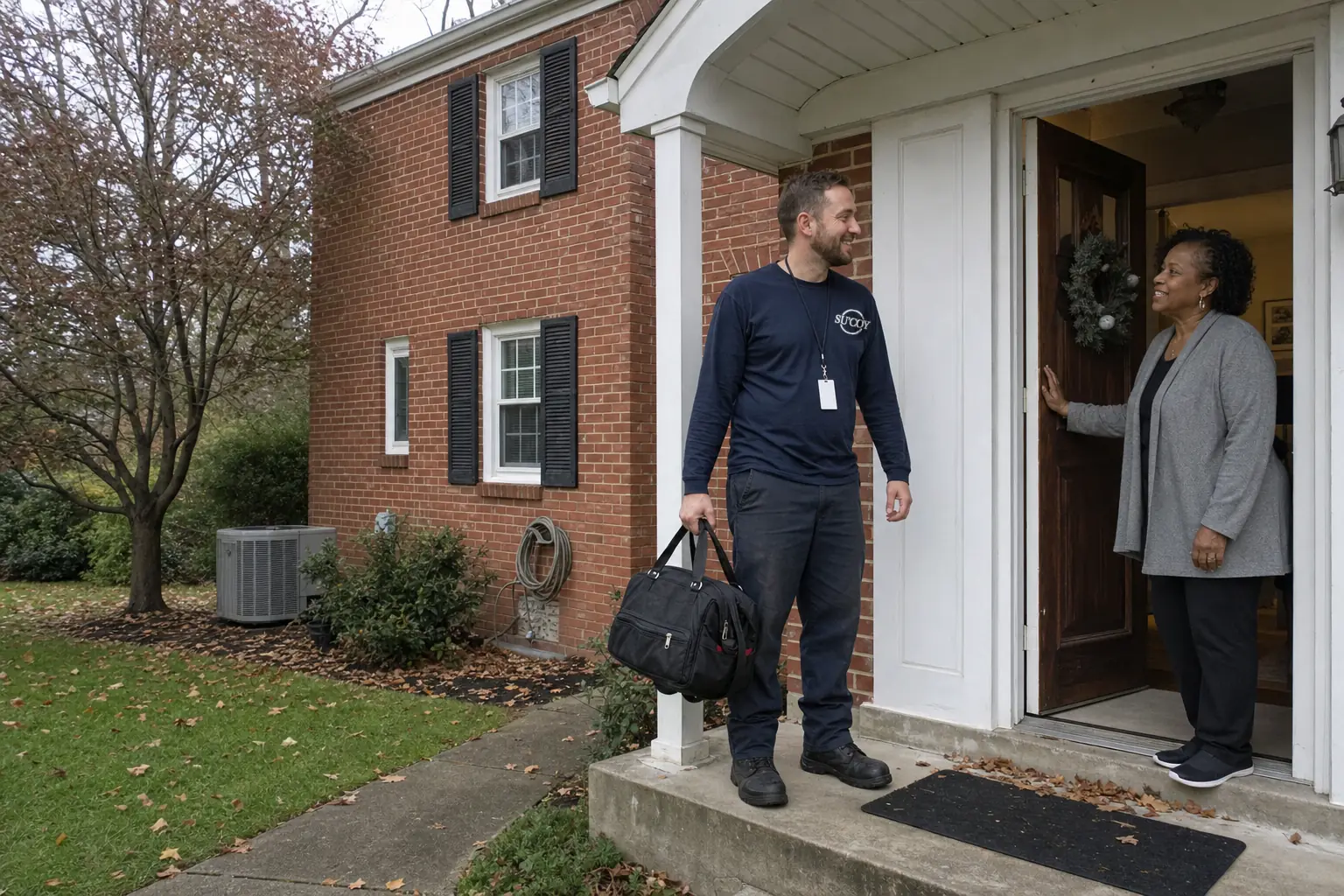
Water Heater Repair Serving Prince George's, Montgomery & Charles Counties and Northern Virginia
- Gas, electric and tankless repaired
- Most water heater brands repaired
- $150 diagnostic, credited to repair
Request Service
Water Heater Repair From a Team That Knows Burners and Venting
A gas water heater has more in common with your furnace than most people expect. Our water heater repair technicians work on the same burners, ignition and flue pipes inside furnaces every day, so the inside of a water heater is familiar ground. Electric and tankless models run on the kind of controls and sensors we test on heating systems all the time, too.
That matters, because hot water trouble doesn't always start inside the tank. Sometimes the cause sits in the venting or the controls around it. We trace it to the real source, then explain what we found in plain words before you agree to a repair.


120 °F
The setting the Department of Energy suggests for most homes, hot enough for showers and dishes.
Every3 months
How often to drain a quart from the tank to clear out sediment, per the Department of Energy.
10–15 years
How long a tank water heater usually lasts, so repairs pay off best before then.
150 psi or 210°F
The pressure or heat that opens the relief valve, which keeps the tank from bursting.

What Your Water Heater Is Trying to Tell You
Water heaters work every day of the year, so a small fault rarely stays small for long. Read the sign right, and you'll usually know which part to blame.
Hot Water That Runs Out Halfway Through a Shower
On an electric heater, the lower element has often burned out, so only the top of the tank heats. Leave it, and the upper element carries the load alone until it fails too.
Rumbling or Popping From the Tank
That's water boiling under a layer of sediment on the tank's floor. The burner or element has to heat through it, so the steel runs hot and the tank wears out years early.
A Pilot Light That Won't Stay Lit
A worn thermocouple can't sense the flame, so the gas valve shuts off for safety. Keep relighting it, and you're hiding the problem rather than fixing it, while every shower in the house stays cold.
Rusty or Brown Hot Water
The anode rod inside the tank is there to corrode so the steel doesn't have to. Once it's used up, rust moves on to the tank itself, and a new rod costs far less than a new tank.
Water Dripping From the Relief Valve Pipe
The valve opens when the pressure or temperature climbs too high, often because the thermostat is set too hot. A steady drip wastes water, and a valve that sticks leaves the tank with no safety outlet.
No Hot Water at All From an Electric Heater
The high-limit switch may have tripped after a thermostat stuck on. A reset brings the heat back, but if it trips again, the thermostat is pushing the water toward scalding.
Hot water that runs short, a rumbling tank or a pilot that quits usually traces back to one part we can replace. Once it's in, the tank goes back to work. Water seeping from the tank's own body is different, because corroded steel can't be patched. So the next step there is water heater installation and replacement, and it's a good moment to look at tankless or heat pump models.
How Much Does Water Heater Repair Cost?
Water heater repair usually costs between $150 and $750, and the part that failed decides where you fall. If it's a thermocouple or an electric heating element, expect around $150 to $450. A gas control valve is a bigger job, so plan on $300 to $750. Tankless models cost more to fix, since their circuit boards and sensors are pricier parts.
Where the heater sits matters too. One tucked into a closet or attic takes longer to reach than one in an open basement. And if the tank itself is leaking, there's no part to replace, so we'll talk about a new heater instead.

Which Water Heater Problems Are Worth Repairing?
It Depends on Which Part Failed
Most water heater parts can be replaced on their own, which keeps a sound tank working for years. The tank is the exception, because a leak there means the steel has corroded from the inside. Here's how the common failures usually play out, so you know what to expect before we arrive.
| If this part failed… | What usually happens |
|---|---|
| Thermocouple or flame sensor | Replaced, and the pilot or burner lights again |
| Electric heating element | Replaced, ideally with the tank flushed so sediment doesn't bury the new one |
| Thermostat or high-limit switch | Replaced, then tested at a safe temperature setting |
| Anode rod | Replaced, which can add years to a tank that isn't leaking yet |
| Temperature and pressure relief valve | Replaced, since it's the tank's main safety device |
| Gas control valve | Repaired on a newer heater; priced next to replacement on an older one |
| The tank itself is leaking | Replaced, because a rusted-through tank can't be patched |

Why Homeowners Choose Us for Water Heater Repair
Why Our Water Heater Repairs Hold Up
A Leaking Tank Gets Help at Any Hour
Water heaters don't wait for business hours to leak. With 24/7 emergency service, a tank spilling into your basement gets dealt with that night, not on Monday. You won't spend the weekend mopping and hoping the floor holds.
Tankless Units Descaled, Not Just Reset
Hard water leaves scale inside a tankless unit's heat exchanger, and the unit shuts itself down to protect it. Clearing the error code only buys a day or so of hot water. We flush the scale out, so your showers stop going cold halfway through.
A Pilot Problem Checked All the Way to the Chimney
A gas water heater often shares its chimney with the furnace. If that flue is blocked or drafts poorly, the pilot keeps going out, however many thermocouples get replaced. We work on furnaces every day, so we check the vent both appliances share.
How Our Water Heater Repair Works
From the first call to hot water at the tap, here's what happens.

1. Tell Us What the Water Is Doing
Let us know whether it's cold, lukewarm, rusty or leaking, and whether the heater runs on gas or electricity. A photo of the label on the tank helps, too.
2. We Find the Cause
Our technician tests the parts behind the problem, from the thermocouple or elements to the relief valve. Then we check the tank for rust and sediment, so you'll know if a repair will last.
3. You Approve the Price in Writing
You'll see every cost on paper, with replacement priced beside it when the tank is aging. Nothing is replaced until you say yes.
4. Hot Water Back at the Tap
With the new part in, the heater goes through a full heating cycle. Our technician checks the water temperature at a faucet and makes sure the relief valve and venting work before leaving.

Is Your Water Heater an Emergency?
Water on the Floor Can't Wait for Morning
A water heater emergency is about damage and safety, not a cold shower. A tank leaking onto the floor, a relief valve pouring water or a gas smell near the heater all need attention right away. Lukewarm water can usually wait until the next day.
Call Us Right Away If…
Water is pooling under the tank, or the relief valve won't stop running. The same goes if someone at home can't go without hot water, like a newborn. Smell gas? Get outside, then call your gas company.
What to Do Before We Arrive
Close the cold water valve on the pipe above the tank. Then turn the gas knob to off, or switch off the heater's breaker. Keep everyone clear of the relief valve pipe, since that water can scald.
Request Service
Water Heater Repair Across Maryland and Northern Virginia
If you're looking for water heater repair in Prince George's, Montgomery or Charles County, or in Northern Virginia, our technicians cover all four. Don't see your town below? Ask us, and we'll tell you whether we can reach you.
Prince George's County
Charles County
Montgomery County
Northern Virginia

What Homeowners Say About Our Water Heater Repairs
“SuCoy has serviced my units several times throughout the years and every experience has been exceptional. He assures that his team are knowledgeable and professional throughout their stay. I’ve been pleased with this company and will always refer and continue to use their services. They also provide reasonable prices and not out here scamming people. Great job SuCoy continue to provide top notch service!!!”

“Su’Coy Heating, AC & Duct Cleaning did a great job on our service call. The technician was professional and took the time to clearly explain exactly what the problem was and what needed to be done to fix it — no confusing jargon, just a straightforward, honest breakdown. It’s rare to find a company that communicates that clearly, and it made the whole experience stress-free. Highly recommend them for anyone who wants quality work and technicians who actually explains things instead of just handing you a bill.”

“Sucoys Heating, A/C and Duct Cleaning did an amazing job from start to finish. Very professional, on time, and knowledgeable. They explained everything clearly and made sure the work was done right. My system is running better than ever and the air quality in my home feels much cleaner. Great customer service, fair pricing, and quality work. I highly recommend them to anyone looking for reliable HVAC service!”

“Su’Coy HVAC by far has been the absolute Best HVAC company that we’ve used in the past 15 years. Prior to working with this company we had so many problems with all the other vendors in the county that we tried. But this company has been, excellent and provided excellent service and installation for my mother-in-law as well. The thing we appreciate the most is they always went out of out of their way to explain exactly what was going on with our systems and did not try to price gouge us!!!”

“I had a great experience with Su'Coy HVAC Company servicing my HVAC unit. The staff was amazing—professional, friendly, and helpful throughout the entire process. I was very pleased with the service I received and truly appreciated the overall experience. I definitely plan to use them again in the future and would recommend them to others looking for HVAC service.”

Water Heater Repair FAQs
Why does my hot water smell like rotten eggs?
Usually it's bacteria in the tank reacting with the anode rod. It's rarely harmful, and a different anode rod plus a flush often clears it. You'll only notice it on the hot side.
Can I relight my water heater's pilot myself?
Yes, if you follow the steps on the heater's label. If it goes out again within a day, stop relighting it, because the thermocouple or the venting needs a look.
How do I reset an electric water heater?
Switch off its breaker, remove the upper panel and press the red reset button. If it shuts off again within days, the thermostat or an element needs testing, not another reset.
Why is there water in the pan under my water heater?
It isn't always the tank. A dripping relief valve or a loose fitting on top can fill the pan, and each of those is usually a simple repair.
Can a water heater explode?
It's very rare, because the relief valve opens long before the pressure gets dangerous. That's why a relief valve that's rusted, stuck or plugged needs replacing right away.
Does Su'Coy Heating, AC & Duct Cleaning repair tankless water heaters?
Yes. We repair tankless, tank and heat pump water heaters, gas and electric, from most major brands, in homes across Maryland and Northern Virginia.
Recent Water Heater Repair Jobs
Request Your RepairHot Water Tips From Our Technicians
7 Tips for Affordable Furnace Installation Services
Optimize your furnace installation experience with 7 essential tips that can save you money—discover what you need to know before making a decision!
Read the article
Is Your HVAC System Circulating Mold? 5 Red Flags Every Homeowner Should Know
You may not see mold inside your HVAC system, but you can often feel its effects.
Read the article
Tax Credits for Heat Pumps
Just imagine saving money and improving energy efficiency with tax credits for heat pumps; find out how before the deadline!
Read the article