Skip to content

table{width:100%;border-collapse:collapse;margin:20px 0}table thead{background-color:#f5f5f5}table th{border:1px solid #ddd;padding:12px;text-align:center;font-weight:bold}table td{border:1px solid #ddd;padding:12px;text-align:center}
As heating season approaches, many Washington DC homeowners wonder whether the ductwork needs attention before the furnace starts running every day. You do not want to pay for a service your home does not need, but you also do not want to spend the winter circulating whatever has been sitting in the system since spring.
There is no single answer, because it depends on the age of your home, what the system has been exposed to, and what is actually inside the ducts right now. This guide walks through when duct cleaning is genuinely worth doing, when your money is better spent elsewhere, and how to tell the difference before you book anything.
Why Does This Question Come Up Before Heating Season?

Timing is the reason. From roughly April through October your ductwork moves very little air, so anything that settled during the cooling season simply sits there. Once the first freeze arrives, usually around November 20 in the District, the furnace runs most days and that material starts moving again.
The other factor is what a Washington summer leaves behind. Warm, humid air moving through sheet metal creates the conditions for growth at the coil and in the drain pan, and spring tree pollen from oak and maple gets drawn into the return through open windows during April. Autumn is simply when the result becomes visible.
When Is Duct Cleaning Genuinely Worth Doing?
Some situations clearly justify the work. If your home has been through renovation, if debris is visibly coming out of the registers, or if there is evidence of pests in the ductwork, cleaning solves a real problem rather than an imagined one. Duct cleaning tends to be worth the money when:
- Dust visibly puffs from supply registers when the system starts
- Drywall dust or sawdust entered the system during recent construction work
- There are droppings or nesting material near basement ductwork
- Visible growth appears at register edges or on the evaporator coil
- The system has never been cleaned and the home is several decades old
- A musty smell arrives with the heat and persists beyond the first week
In those cases the work removes material that is genuinely being delivered into your living space, and the difference is something you can see at the registers afterward rather than something you have to take on faith.
What Signs Suggest Your Ducts Actually Need Attention?
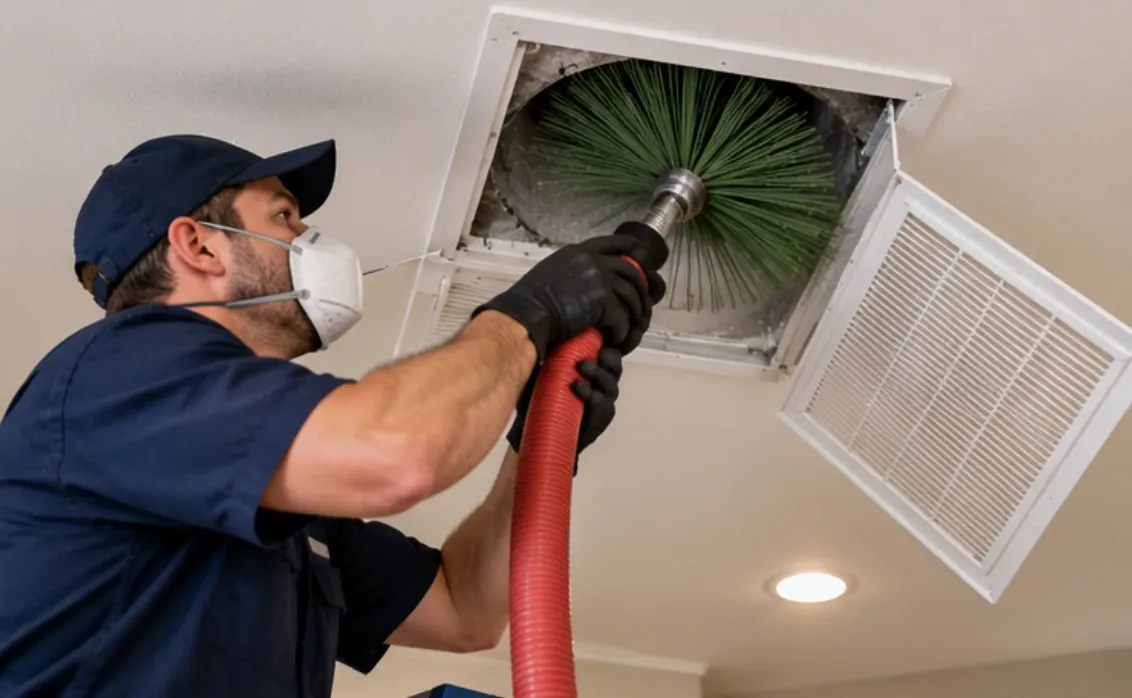
Most of this you can check yourself in about ten minutes. Run the system, walk the house, and look at the registers rather than the furniture, because household dust settles on shelves from sources that never touch your ductwork.
Signs Your Duct System May Need Cleaning
| What You Notice | Why It Matters |
|---|---|
| Dust puffing from registers on startup | The system is actively delivering debris into your rooms |
| Filter turning gray within three or four weeks | Unfiltered air is entering somewhere, often at the return |
| Musty smell that starts with the system | Usually moisture at the coil rather than dust in the ducts |
| Visible debris around register edges | Material has accumulated enough to reach the openings |
| Renovation work in the past twelve months | Construction dust loads a system faster than years of living |
| Rooms that never seem to clear of dust | Worth investigating, though many causes are unrelated |
When two or more of these appear together, an inspection is worth booking. A single sign on its own usually has a simpler explanation than dirty ductwork.
Does Older Housing Always Mean Dirtier Ducts?
Age matters, but it does not settle the question by itself. A century-old row house with sealed ductwork and a well-fitted filter can be cleaner inside than a newer home where the return plenum has gaps and the filter has been left in for eight months.
What matters more is where the equipment lives and how well the return is sealed. Homes with the furnace and return in an unconditioned basement pull basement air into the system continuously, while ducts running through a crawlspace draw humidity instead. A professional inspection weighs those conditions alongside age rather than relying on the date the house was built.
How Do Filters and Ductwork Work Together?
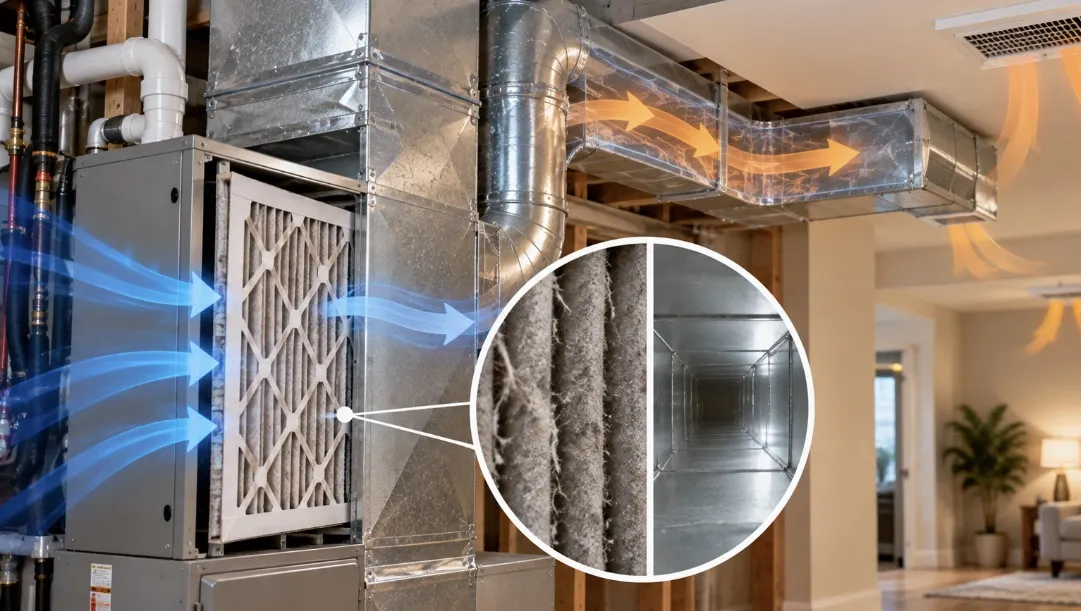
These are two different jobs and they are often confused. Your filter controls what enters the system from today onward, while cleaning addresses what has already accumulated inside the ducts over previous years. Getting the filter right is the cheaper half and usually the first thing to fix.
- Change a standard one-inch filter roughly every three months
- Shorten that to about six weeks during April pollen or with multiple pets
- Choose a MERV rating your blower can actually pull air through
- MERV 8 handles household dust, MERV 11 catches finer pollen and dander
- A filter restricts airflow well before it looks visibly dirty
- Seal gaps around the return so the filter is not being bypassed
If your filter is turning gray within a month, that is the problem to solve first. Cleaning ducts without sealing the return simply means the same material accumulates again by the following season.
What Should You Ask Before Booking a Duct Cleaning?
The equipment that arrives at your home determines whether the work is worth paying for. A few questions separate a thorough job from a vacuum run down a handful of registers.
- Will the system be inspected with a camera before you receive a quote?
- Is a negative air machine used to put the ductwork under suction?
- Is that vacuum HEPA filtered to contain fine particulate?
- Are rotary brushes used, or is the work vacuum only?
- Are any treatment products pet-safe and low odor?
- Are registers, grilles and the blower compartment included?
Asking about products matters more than homeowners expect, particularly with pets or young children at home. Low-odor and pet-safe options are widely available, and there is no reason to accept something that requires leaving the house for the afternoon.
What Does a Professional Duct Cleaning Include?
A professional duct cleaning should be more than running a vacuum through a few registers. For a Washington DC home, the technician should first determine whether cleaning is actually warranted, then use equipment and methods appropriate for the duct material and the amount of debris present.
A typical residential cleaning may take two to four hours, although larger homes, multiple systems, difficult access, or significant contamination can extend the job. The important part is that the work removes material from the system rather than simply disturbing it.
Inspecting the Ductwork Before Cleaning
The process should begin by examining the accessible ductwork, registers, return areas, and HVAC components. Where appropriate, a camera can provide a closer look at interior surfaces and help establish whether the system actually contains substantial debris or contamination.
Setting Up Negative Air Pressure
A professional vacuum system places the ductwork under negative pressure while cleaning takes place. This helps pull loosened material toward the collection equipment instead of allowing dust to circulate through the home.
Agitating Dust and Debris From Duct Walls
Rotary brushes or controlled compressed air can loosen material that has adhered to the interior surfaces. The cleaning method should match the duct construction, since aggressive agitation is not appropriate for every type or condition of ductwork.
Cleaning Registers and HVAC Components
Registers and grilles should be removed and cleaned rather than simply wiped around the edges. Depending on the scope, accessible components such as the blower wheel, cabinet, and return areas may also need attention when they contain significant buildup.
Treating Confirmed Biological Growth
If an inspection confirms biological growth, the affected areas can be addressed with an appropriate treatment. It should not automatically be sprayed throughout the entire duct system simply because a cleaning is being performed.
The goal is to leave the system with the specific contamination identified during the inspection removed or addressed. If damaged, disconnected, or poorly sealed ductwork is discovered during the process, that is a separate issue that should be repaired rather than covered up with cleaning.
What Will Duct Cleaning Not Do for Your Home?
It will not lower your heating bill in any measurable way. Restricted airflow comes from filters, undersized returns and duct design rather than from dust resting on a duct wall, and savings claims attached to duct cleaning rarely hold up.
It will not cure allergies either. Filtration affects the air you actually breathe, so a correctly sized MERV 11 or 13 filter changed on schedule does considerably more against spring pollen than removing settled debris. Where indoor air quality is the real concern, indoor air quality services address filtration and ventilation directly.
It also will not fix a moisture problem on its own. If growth is present, the source has to be corrected or it returns, which is why mold removal and remediation is separate work with its own process.
How Often Should Ducts Be Cleaned in a DC Home?
There is no magic number of years that tells you when your air ducts need to be cleaned. If someone tells you that every DC homeowner should schedule duct cleaning every three or five years, that is too simple. What matters is what has actually accumulated inside your system and what has happened in the home since the last inspection.
A home that has gone through a major renovation, dealt with rodents, or has visible debris coming from several registers may need attention sooner. Another home could go many years without needing duct cleaning at all. The condition of the ductwork matters more than the calendar.
What Can Change How Often Your Ducts Need Attention?
A few things can make a noticeable difference in how quickly dust and debris build up:
- Recent remodeling: Drywall dust and sawdust can enter open registers during construction.
- Multiple pets: More hair and dander can move through the return-air system.
- Pest activity: Rodents or insects inside the ductwork create a specific reason for cleaning.
- Moisture problems: Water intrusion or persistent condensation can create conditions for biological growth.
- Poor return-air sealing: Gaps can pull dusty air from basements, crawlspaces, or other areas.
- Visible debris at registers: Repeated debris coming from multiple vents deserves a closer look.
The same principle applies if you have recently bought an older DC home. Instead of automatically paying for a full cleaning because the previous service history is unknown, have the accessible ductwork inspected first. You may find substantial buildup that warrants cleaning, or you may find a system that is perfectly serviceable as it is.
Why Choose Su’Coy Heating, AC & Duct Cleaning for Duct Cleaning in Washington, DC
The right answer is not always cleaning, and a company willing to tell you that is worth more than one selling a schedule. An inspection should come before a quote, and you should be shown what was found rather than simply told about it.
At Su’Coy Heating, AC & Duct Cleaning, we have served homeowners across Washington DC and Prince George’s County since 1996. Our EPA-certified technicians inspect with a camera, use negative air pressure with HEPA-filtered vacuums, agitate with rotary brushes rather than relying on suction alone, and include registers, grilles and the blower compartment in the work.
If dust is coming from your registers, you have recently finished renovation work, or something smells damp when the heat starts, book an inspection before the heating season takes hold. Call (301) 888-0037 or see our duct cleaning service to understand what a visit covers.